Showing posts with label Lessons. Show all posts

Tuesday, December 9, 2008

Surviving In Deep Water - Hope Floats

So, earlier this month when I wrote a post about the virtues of poor people food, I made a reference likening turning your clothes into a flotation device in deep water with making it through the current economic torrent. Whether you’ve lost your job, your retirement or your house, or the financial bail-outs haven‘t succeeded in bailing you out yet, these five steps can make all the difference in your ability to survive and thrive. While these tips could be applied to many money matters, I’m really not qualified to give you financial advice. My goal is to help you keep your head above water with more of your food money staying with you and less of it going to the grocery store.

As promised, here are the steps to surviving in deep water by creating a life-saving device from what you already have. Remember, this is a metaphor.

1. Don’t Panic - Tread water.
This is where you asses your current situation. In the case of groceries, figure out where you are with the food you currently have in you cupboards, pantry, fridge and freezer. Do you have a month’s worth of food, a week, a few days? Make an inventory and the beginnings of a menu from what you find. Remember, calm. Panic will drown you at this point.

The food in my pantry when I started my experiment. This lasted a month and fed 6+ people all month long.

2. Kick off your shoes, they are a impediment to floating and movement.
Where do your weaknesses lie? What is keeping you from achieving your financial goals? For me, it’s waste. Wasted time, wasted money, wasted opportunity. The USDA reports that American consumers waste 26% of the food they buy from grocery stores and restaurants. Are you wasting 26% of your food budget? At this juncture all non-essentials are considered waste, they’ll just drag you down and keep you from moving in the direction you need to go. Be careful in deciding what is imperative (Read on because though you drop the shoes, the laces can still come in handy.) Kicking off your shoes also reminds you to relax. Metaphorically speaking , what are the shoes on your list of grocery items?

3. Take your pants off and modify them to float.
Now that you’ve considered your weaknesses, ponder on your strengths. Before I started my No More Grocery Shopping experiment, I knew my greatest strength in the grocery department was my well stocked pantry combined with my ability to cook cheap and easy food. This is how I stay afloat during hard times. What is one thing you can do right now to prepare for the challenges of the coming meals?

This is the produce I had for a month of No More Grocery Shopping

4. Determine if you have any other items that will help you float such as a shirt, dress, tote or anything else that will hold air.
These are supplements to your strengths. It’s the difference between keeping your head above the water and being able to comfortably float until help arrives. Learn to make everything you can; bread, convenience food, snacks and treats, even toys and gifts. In my case, along with a bunch of staple foods, I make sure I have plenty of chocolate, spices, condiments and dressings. What are do you know how to make from scratch? What do you need to learn?
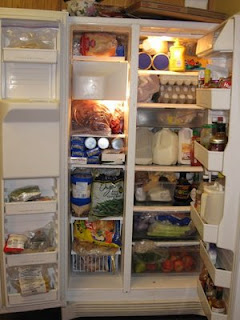
Fridge and freezer food that kept us going for the better part of five weeks+.

5. Keep socks, bras, belts and shoe laces, these can help tether your flotation device to you. Lose the jewelry and the wallet and anything else that will weigh you down.
As with any new endeavor, there will always be practical ideas to keep in mind. Use the best of what you find, let the rest go. Pick a few things and work on them. Don’t get weighed down by the enormity of things to do and learn. You can survive and thrive if you learn this important principle: Keep what’s useful to you, mostly keep it simple, and let go of the rest.

End Note - After all is said and done, don't forget, despair will sink you quicker than a stone, but hope floats. And, chocolate is an essential part of any survival plan.

Check back Thursday for Homemade Holiday fare including gifts, toys, ornaments and of course cheap and easy holiday recipes.

Friday, December 5, 2008

Lesson 3B - Simplify Your Lists - Look at your shopping list

For this No More Grocery Shopping experiment I decided I wanted to cut my time and money spent on acquiring and preparing food in half. That inspired me to look at other areas I would like to liberate myself from. For instance, I tossed my daily to do list months ago in favor of writing things on the calendar. I do forget things occasionally, but oh well, I’m not tethered to a list. Another list I simplified is in the area of gift giving. And, I made my menu easier to call to mind (hmm, Multi-cultural cuisine or Soup Night). But it all started with a master grocery shopping list and this lesson:

Make your grocery shopping list work for you.

As part of the simplification process, decide what you want your life and days to look like. Do you want to be bound or do want to be free? Does your list and the things on it hold you captive or offer you freedom?

2 Tips to Put You on the Path of No More Grocery Shopping
(or at least keep you out of the store 28 days of an average month)

1. Start with a master list. This is a list of all the things you buy and eat regularly. Go through your fridge, pantry and cupboards to see what those things might be.

Here is a really cool, highly commercialized interactive grocery shopping list creator.
http://www.scottcommonsense.com/Tools/GroceryList/Tool.aspx?WT.srch=1&WT.mc_id=7667343&iq_id=7667343

Here’s one that is not interactive and doesn’t require you to sign up.
http://www.heart4home.net/downloads/master_grocery_list.pdf

2. Make a list for non-food and non-perishable items and buy in bulk. This list could include:

Non-Food Items
Hygiene things - tooth paste, hair care, skin care, soap, deodorant, personal care stuff
Paper goods - toilet paper, paper towels, napkins, paper plates & cups, plastic utensils
Cleaning Supplies - household cleaning stuff, laundry soap, dish soap & dishwasher detergent
First Aid Supplies - alcohol, peroxide, bandaids & bandages, latex (or other) gloves, q-tips, cotton balls, etc.

Non-Perishable Foods
Flour
Sugar
Oil
Dressings/Condiments
Herbs/Spices
Grains
Beans and Sproutable seeds
Pasta
Canned produce

This list could go on and on and I could say a lot about each item. I‘ll spare you that for now, but click here for a list of good long term storage foods.

When you finish your list, print out as many copies as you need for the year of shopping. Then circle, check or otherwise note items you need before you head for the store. Because I’m going to do the No More Grocery Shopping Experiment next year I have some goals for what that will look like for me. If I typically shop for food every two weeks, and want to cut that time in half, I’ll plan to go only once a month all year. So, I’ll make 12 copies of my food lists. For my non-food/non-perishables list, I plan to go from buying those things every-other month 3 times a year in January, May and September. So, that’s 3 copies of that list.

When it’s time to figure out what to eat and shop for in the month, look at your master menu and your master shopping list. Decide what you have, what you need, and most importantly, what you could probably do with out or make from scratch. Check the items on your list you’ll need to purchase and go for it.

My challenge to you is to use the master menu and master shopping list to cut your food acquisition/preparation time in half. Do you think you can do it?

Tuesday, December 2, 2008

An Obscenely Long Post - Lesson 3A - Simplify Your Lists - Start with Your Menu

Happy kids ready to eat. Leave it to the littlest to make faces over the food.
If you couldn’t tell by now, I am a rambling writer, meandering around wherever my last epiphany ended. For that reason, keep in mind that I’m not sharing these lessons I’m learning in order of importance. Instead, I’m sharing them in the order that they occur to me, and while I know this is not the most logical, orderly way to proceed, I can’t help but stop to note the concepts as they come, even if it means backtracking later. You guys are all along for the ride on this experiment. Occasionally, I clean house and put posts into labeled categories on the side bar. If you’re looking for something in particular, I hope you find it there. If not, email me at nomoregroceryshopping@gmail.com.

Now, after your long, patient wait through my sprawling scrawl, I’ll get on with it. In my month of minimizing holiday mayhem, here is lesson three -
Simplify Your Lists - Start with Your Menu
We already talked about the liberation that comes from limiting your expenditures, but what are your lists? Here’s a look at one of my more complicated lists, my menu, and how I‘ve simplified it.
My menu used to be a mess. It was a long list of all the stuff we’d eat in a month of dinners and I’d plug one meal in for each day of the month, maybe hitting some of them twice, but always feeling overwhelmed by the enormity of the list and the inventory of food that accompanied it. A few years ago, I decided to simplify my process. To do this, I had to go back to that messy list and turn it into a master list. Then I assigned a category like Pasta Night or Bread & Salad Night to each evening of the week. Click here to see my big list of main meals and how I’ve categorized everything.
Now, rather than plugging meals in all over the calendar, each night of the week has it’s own theme. The order may be slightly different each week but the outcome is the same. We eat simpler meals that require very little fore-thought. Now, my week looks something like this.
Sunday - Pasta Night
I am Sicilian and we love our pasta. Almost every Sunday we make up a couple’a pounds of pasta, a couple’a types of sauces, a big loaf of bread or foccacia and a giant salad that never gets eaten all the way. Sometimes there’s meat, sometimes the whole meal is vegetarian. Always, we feed a small army, work up a hearty appetite, and share lots of good laughs in the process. If you’ve ever heard the phrase “too many cooks in the kitchen,” you can imagine my house on Sunday’s.
Monday - Soup or Salad Night (depending on the season)
Here we choose the soup we have ingredients for or feel like having that night. Sometimes our choice is motivated by the leftovers in the fridge, or the cream that is going to expire in a few days. When we do salad as the main course we make a salad with lots of colors in it besides green. Sometimes we add bacon or chicken, other times we go vegan. Whether we have soup or salad, I always try to make some sort of bread, a nice wheat or corn bread, tortillas or scones, to go on the side and give us a little more substance.

Tuesday - Pasta Night Replayed
Sometimes it’s leftovers from Sunday’s meal, other times it’s a completely new concoction, but almost every week we have pasta more than once. Sometimes I serve bread on the side, sometimes a veggie like braised green beans, always there is a green salad to go with all our carbs.

Wednesday - Multi-Cultural Cuisine (other than Italian)
We love Thai, Indian, Mexican, Chinese, Japanese and European traditional foods we’ve Americanized. We choose from the list, depending on what we have and what we’d like and that’s that.

Thursday - Potato Bar or Sandwich Night (again, depending on the season)
Again, we always try to provide plenty of fresh color to counter the copious amounts of cheese, bacon, butter and sour cream we smother our potatoes in.

Friday - Fun Food and LeftoversUsually I’ve used leftovers in other meals, but occasionally we have a surplus and we’ll have those along side one of our favorite fun foods so we have our own sort of smorgasbord. Sometimes we have pizza (frozen or homemade) or buffalo wings, sometimes burgers and fries. Always quick and easy fun foods.

Saturday - Date Night
Kids eat kids food like ramen or mac & cheese. Mom and Dad eat out.
So, to reiterate the simplification process: Make a master menu and put individual items into categories. Now, give each night of the week an assigned category and go from there. Have at least one vegetarian meal and one soup or salad night. A well stocked pantry makes this process easier and more enjoyable.

Maybe you have an easier way of doing the whole meal planning process. How do you do it and what makes it work for you? According to the USDA we spend almost an hour preparing and cleaning up dinner each day. What if we could cut that time in half? What would you do with an extra 3+ hours in a week? Share your ideas with us we could all use a little more time.

Monday, December 1, 2008

Bargain Brags and Lesson 2 - Liberate Yourself, Limit Your Expenditures

I saved $45 at Bath and Body Works on Black Friday!

BargainBrags(.blogspot.com) is a blog my sister-in-law, Tiff, maintains. This little vignette belongs on her blog, but I wanted to share it here. It was KC’s birthday on Black Friday. Actually, she was born on Black Friday, but I had no idea that it even held that title until this year. Anyway, we got back from our trip late Friday evening, but not too late to hit the mall for my promised gift to KC. She got her ears pierced and it was a great adventure. She is such a cool girl, she was hardly even nervous. After we chose her first pair of earrings and they were forced through her little lobes, we decided to hike upstairs to Bath and Body Works. There they had several lovely items on sale; items I’ve had my eye on for a while and have waited for a sale on.

Wallflowers are little plug-in scented oil diffusers wit h delightful fragrances to choose from. They were on sale for $5.

After some deliberating, I chose 3 Wallflower starter sets and 3 refill packs at. Not too bad, $30. I made my selections, and went to stand in line. While I was there, I found the softest socks in the world. They were made with aloe and only cost $5, the same price of every other item in my stack of stuff, I wanted to give them as gifts and chose 3 from the shelf. While I waited in that tedious line (beginning to understand the term Black Friday) I began to consider each item in my arms. As I thought about the things I thought I wanted so much, I remembered the dozen or so scented candles waiting to be burned at home. Additionally, I have a closet full of essential oils waiting to be used in creative new ways to fill the same purpose the Wallflowers would. I thought about our financial goals, and while every item I held only cost $5, all together they added up to $45 and that was a modest sum. So, guess how I saved $45 dollars at Bath & Body Works. I left all of my stuff on the table next to me in line. That was it. So, there's your lesson #2:

Liberate yourself by limiting your expenditures.

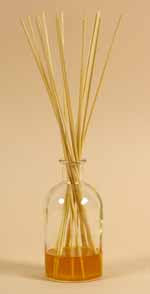
This morning I went through my closet and found that I have the makings of some great gifts. My husband has been wanting a bamboo reed scented oil diffuser for his office. I could make several from what I have here at home. We are trying to make, or recycle, at least one gift for each member of our family. This can be my home made gift to him. More on that later. Now to the moral of the story.

The gift I'm giving my husband for his office. It will only cost me a couple of bucks to make it.

Sometimes all we need to do is hold the things we think we need and then consider the things we already have that could work just as well. Sometimes we need to think about the time and energy the purchase of that item will cost you in the end, how many hours would you or your spouse have to work to come up with that sum. Even if it’s only one hour, what you do with one free hour? Just a thought. I have done this exercise a few times. Never deliberately, but it always teaches me something.

So, that’s to do with holiday gifts or sale items. What about your grocery shopping list? What about all the parties and errands and people to see to this season? Is there a way to limit your expenditures in time and money to make room for the things that really fill you? What would you do with a liberated hour purchased by your ability to limit your list of stuff to do and things to buy?

Sunday, November 30, 2008

Lesson One - Make a List

A few of the crew on Thanksgiving at the homestead. We could call this one
Three Bald Guys and a Piece of Pie, but I don't think they'd laugh.

We did go away for Thanksgiving. We had a great trip and all was well when we got home. I did learn a few important principles on our journey, and since I said the purpose of this post would be to help minimize the mayhem of the holiday scene, I figured I’d share my discoveries with you. This exercise is meant to help keep you out of the grocery store, as much as possible, and cause you to consider what is really important to you this time of year. The theme is SIMPLIFY and learn from my mistakes, I made them for your benefit. So, here goes:

Do like Santa - Make a list and check it twice

Lists are great, they can act as a blueprint for your best laid plans. Whether your making a trip to the grocery store or to your in-laws for three days of family festivities, the list can save you time, money and grief. Once your list is made, you need to look it over critically and carefully. Contemplate the cost/benefit ratio of each item. Do you really get as much pleasure from your pumpkin-puffed-pastries as you do pain in purchasing the required supplies, unloading your purchases at home, putting all the items away, getting them all out again, assembling your recipe, waiting for it to come out of the oven, etc, etc, etc. If you can say the balance tips in favor of benefit for each item, keep it. Otherwise, ditch it.

Also, lists can provide a reality check to your pie-in-the-sky schemes - Here’s a list of food three families thought would be great for our Thanksgiving meal, followed by what really happened. Remember we were feeding 14 people the all-American meal symbolic of our prosperity and abundance, but also note, this was for one meal:
2 turkeys
1 ham
10 pounds mashed potatoes
8 streuseled sweet potatoes
4 dozen rolls
Stuffing
Gravy
Green bean casserole
Relish tray - carrots, tomatoes, celery, olives, pickles, broccoli, cauliflower, cucumbers
Cheese tray - cheese roll with 3 kinds of crackers
Green salad
4 pumpkin pies
2 banana cream pies
1 apple pie
1 pecan pie
1 pan of fudge
2 plates of cookies

Are you exhausted yet, because this is the scaled back version. We had to talk my mother-in-law down from the ledge when we discouraged her from including several additional items, including time-honored treats and stove-top specialties. So, making the list did help us before hand. The problem is, I didn’t put it all on one piece of paper. Our list was broken up into three, you bring this, I’ll bring that, she’ll do the other stuff. That was a mistake. Because our list wasn’t consolidated, we ended up way more than we needed. I’ll know better next time. I’m sure you’re laughing because you would have seen this coming. Just remember, there are all kinds of learners in this world, and sadly I often have to learn the hard way, but you don’t.

Here’s what happened with all of that food.
2 turkeys - we fully consumed one of them, but it took us Thanksgiving dinner and lunch the next day to do it. The other turkey was cooked, carved and sent back to the freezer, where it had begun it’s short life in grandma’s kitchen.
1 ham - I never even saw it, thank goodness.
10 pounds mashed potatoes - we actually peeled, boiled, mashed and ate all of these in one meal
6 streuseled sweet potatoes - delicious recipe contributed by my sis-in-law, sadly we only ate two of them (they were huge) and I don’t know what happened to the rest.
4 dozen rolls - these had a hard time in the high-altitude setting we were in. Still, we ate about half of them, the rest were left for other meals.
Stuffing - we made the perfect amount and had no leftovers or waste - 1 box of Mrs. Cubbisons along with croutons made from one small loaf of whole wheat bread.
Gravy - perfect amount, again
Green bean casserole - we ate about half of this
Relish tray - carrots, tomatoes, celery, olives, pickles, broccoli, cauliflower, cucumbers - we forgot half of the veggies for this back at home. Let’s just say that protein and starch were central to the meal.
Cheese tray - cheese roll with 3 kinds of crackers - this was a yummy before dinner snack, but we only had, and needed, one box of crackers, I brought half of the cheese roll home with me.
Green salad - I forgot the lettuce, so we didn’t have one.
4 pumpkin pies - between breakfast on Thanksgiving day (my tradition), dessert after dinner, and breakfast again the next day, we only ate two of these.
2 banana cream pies - we ate half of one.
1 apple pie - My Caleb ate about half of this pie by himself, and everyone else helped him with the rest.
1 pecan pie - I ate about ¼ of this pie, and a couple of others had a piece each. I left 2 pieces behind with longing backwards glances.
1 pan of fudge - two pieces were taken.
2 plates of cookies - who knows, I lost track of how much everyone was getting, but it did seem like there was at least one full plate of cookies left.

Alright, no more preaching, no more soap boxes. Just throw out the old adage "Make a list and stick to it." Replace it with the saying about Santa. There is wisdom in “making a list and checking it twice.” Learning to discern between what's naughty and nice for your time and money can make all the difference this holiday season.